
How Smart Thermostats Could Lower Your NJ Home's Bills by 8%

Energy bills in New Jersey have been climbing, and it’s getting harder to ignore the impact on your monthly budget. You’re not alone in looking for ways to offset those costs, especially through smart home products that focus on heating and cooling efficiency.
So, how does a smart thermostat lower bills? Our guide breaks down what the data actually shows and what you can expect.
Table of Contents
Why Energy Bills Are Rising in New Jersey Homes
If you’re wondering, “How does a smart thermostat lower bills?” You’re likely also wondering why your bills are so high to begin with and how they keep climbing. There are a few key factors at work:
New Jersey relies heavily on imported energy: New Jersey consumes more energy than it produces, making it dependent on regional markets and price fluctuations.
Electricity prices are already higher than average: Residential electricity costs in New Jersey are nearly 20% higher than the national average.
Large-scale energy users are increasing demand: Growth from AI data centers is contributing to higher overall energy demand, which can push prices upward, especially when supply doesn’t keep pace.
How Smart Thermostats Actually Reduce Energy Use
So, how do smart thermostats reduce energy bills? You’re not just changing the temperature, you’re changing how and when your system runs. Smart thermostats reduce wasted energy by aligning heating and cooling with your actual schedule and habits, with features such as:
Automatic scheduling: Adjusts temperatures when you’re asleep or away, so your system doesn’t run all day.
Occupancy sensing: Detects when the home is empty, reducing unnecessary heating or cooling.
Geofencing: Uses your phone’s location to adjust settings as you leave or head home.
Adaptive learning: Builds a schedule based on your routines over time.
Remote control from your phone: Lets you make quick adjustments if plans change.
Weather-based adjustments: Account for outdoor conditions to avoid overworking your system.
All of these features work together to reduce unnecessary runtime, which is what ultimately lowers your energy use.
How Much Money Can a Smart Thermostat Save You?
You’re typically looking at steady, incremental savings rather than a dramatic drop overnight. ENERGY STAR notes that homes with certified smart thermostats tend to reduce heating and cooling costs by around 8% on average, or roughly $50 per year. Savings may be greater depending on climate, personal comfort preferences, occupancy, and HVAC equipment.
Those savings come from running your system more efficiently while cutting back on unnecessary runtime, which can also reduce wear on key components. Over time, that can mean fewer repairs and potentially a longer lifespan for your HVAC system, adding to the overall cost savings beyond just your monthly utility bill.
Do You Really Save Money by Lowering Your Thermostat?
You do, but only if it’s done consistently. According to the U.S. Department of Energy, “you can save as much as 10% a year on heating and cooling by simply turning your thermostat back 7°-10°F for 8 hours a day from its normal setting.”
The challenge is sticking to that schedule every day. That’s where installing smart thermostats to save on energy bills makes a difference. They handle those adjustments automatically, so you’re not relying on memory or routine to capture those savings.
Smart Thermostats vs. Traditional Controls: Cost Comparison
When you look at a true smart thermostat comparison, the biggest difference comes down to upfront cost versus long-term value.
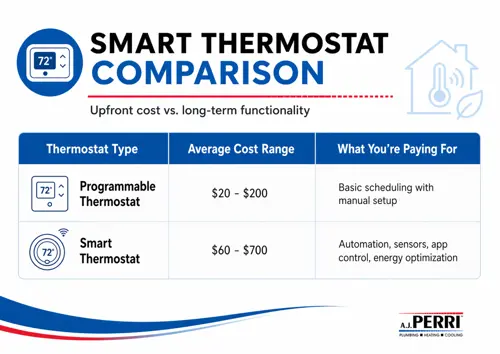
A simple comparison of programmable and smart thermostats shows a clear gap in initial cost, but also significant differences in functionality and potential savings.
Installation is another factor. HomeAdvisor found that “The cost to install a smart thermostat ranges from $200 to $500, with an average installation cost of $350,” including the thermostat, with installation alone costing $100 to $200. Total costs can also vary based on wiring, system compatibility, and the level of automation you want, so it’s important to look beyond the price tag and consider overall efficiency and potential savings.
The Pros and Cons Homeowners Should Know Before Installing
Pros
Proven Energy Savings
You’re not relying on marketing claims by installing a smart thermostat. There’s real data behind it. As mentioned before, ENERGY STAR reports that certified smart thermostats save homeowners about 8% on heating and cooling costs, or $50 per year on average.
That shows up in a practical way: fewer hours your system runs when you’re asleep or away, and less energy wasted maintaining the same temperature all day. Over time, that reduced runtime is what leads to lower monthly energy bills.
Built-In Automation That Reduces Heating and Cooling Waste
You don’t have to constantly adjust the temperature to see savings. Smart thermostats use features like scheduling, occupancy sensing, and geofencing to adjust heating and cooling based on when you’re actually home.
Research from the American Council for an Energy-Efficient Economy highlights how these automated adjustments reduce unnecessary HVAC runtime by aligning energy use with real household patterns.
More Reliable Energy Savings Than Programmable Thermostats
Research from Lawrence Berkeley National Laboratory shows many homeowners either don’t program thermostats correctly or stop using scheduling features altogether, limiting expected savings. Furthermore, Consumer Reports estimated that “40 to 70 percent of programmable thermostat users don’t take advantage” of their device’s features.
Smart thermostats automatically maintain consistent settings, which is a big part of how smart thermostats reduce energy bills in everyday situations.
Helps Reduce Peak Energy Use and Utility Demand
You’re not just lowering your own bills, you’re also reducing strain on the energy grid. Smart thermostats can shift heating and cooling away from peak demand times, when energy is most expensive. Findings from the American Council for an Energy-Efficient Economy show this kind of load shifting can reduce peak demand and improve overall energy efficiency.
Cons
Upfront Cost Can Take Time to Pay Off
You’re making an upfront investment, and the return isn’t immediate. ENERGY STAR estimates average savings of about $50 per year, while Home Advisor found that the average cost for a smart thermostat and installation was $350. That means it can take a few years to offset the cost of putting in a smart thermostat.
Not All HVAC Systems Are Fully Compatible
You may run into compatibility issues, especially in older homes or with outdated equipment. The U.S. Department of Energy notes that some systems, like certain heat pumps, require thermostats designed specifically for that setup, and not all systems support advanced controls. Older HVAC units or wiring setups (such as a missing C-wire) may also limit functionality or require upgrades, which can increase overall costs before you see any real savings.
Privacy and Data Security Considerations
You’re adding a connected device that tracks when you’re home and how you use energy. The Federal Trade Commission advises that smart home devices collect and transmit data, which means they should be properly secured to reduce the risk of unauthorized access. That doesn’t make them unsafe, but it does mean you should use strong passwords, keep software up to date, and understand what data your device collects.
Is a Smart Thermostat Worth It for Older NJ Homes?
More New Jersey homeowners upgrade their smart home with solutions designed to reduce wasted energy, including through ENERGY STAR-certified smart thermostats. You can still see real benefits from a smart thermostat in an older New Jersey home, but it depends on how your system and home perform. Factors like HVAC compatibility, wiring, insulation, and how well your home holds temperature all play a role in how much you’ll actually save.
Where it tends to deliver the most value is when it’s paired with planned upgrades, especially a newer, high-efficiency HVAC system. That combination gives you better control, improved efficiency, and stronger long-term savings. If you’re unsure, A.J. Perri can help you evaluate your setup and walk you through your options so you can make a confident, informed decision.
Get a Smart Thermostat Today
You’ve seen how smart thermostats lower energy bills and can make a measurable difference in HVAC efficiency. Upgrade your smart home with help from A.J. Perri. Call 732-733-2541 or schedule online to have a smart thermostat installed and start saving.