
HVAC Cost Estimator and Market Forecast

What’s it going to cost me? If you’ve asked this question recently, we feel your pain. When it comes to heating and cooling in your home, you’ve likely felt the strain of rising energy costs. Just in the last year, electricity prices have risen 5.1% and natural gas by 11.7% in the U.S. With utility rates climbing, inflation biting, and increasingly unpredictable weather, your HVAC expenses are more volatile than ever.
That’s where our HVAC cost estimator comes in. Even if you don’t have a broken HVAC system, energy-efficient upgrades are becoming a necessity with all the rising costs. Let’s dive deep into an HVAC market forecast for New Jersey, so you can plan smarter this season.
Why HVAC Costs Are Rising in New Jersey
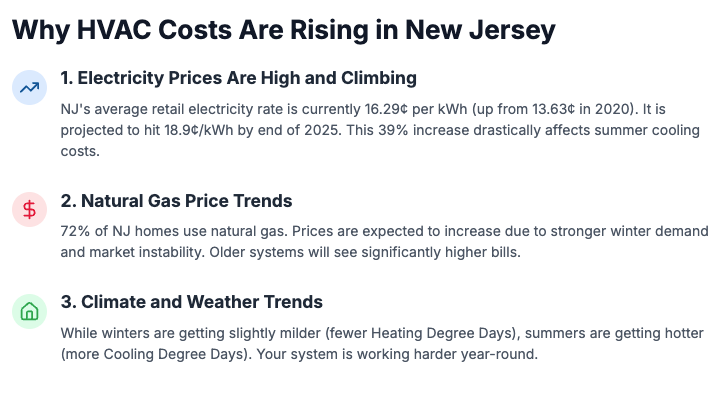
1. Electricity Prices Are High and Climbing
The latest data from the Energy Information Administration show that New Jersey’s average retail electricity rate is currently 16.29¢ per kWh, which is up from 13.63¢ per kWh in 2020. And it is projected to increase to 18.9¢/kWh by the end of 2025, representing a nearly 39% increase in the last 5 years alone.
Higher electricity rates particularly affect air-conditioning costs during New Jersey’s increasingly hot summers, making cooling a larger share of your annual HVAC expenses.
2. Natural Gas Price Trends Are Increasing Heating Costs
About 72% of New Jersey homes use natural gas to heat their homes, while 17% use electricity. Since most households use gas, changes in gas prices directly influence your winter HVAC expenses. According to the U.S. Energy Information Administration’s Short-Term Energy Outlook, residential natural gas prices in the Mid-Atlantic are expected to increase during the next heating season, driven by stronger winter demand and ongoing market instability.
This means you’re likely to see higher heating bills this winter, especially if your system is older or less efficient. When you combine those rising heating costs with New Jersey’s already high electricity rates, your total annual HVAC expenses could climb more than expected.
3. Climate and Weather Trends Fuel Demand
New Jersey’s long-term climate data helps explain why HVAC systems are under persistent strain and why your heating and cooling costs may be rising. To measure HVAC needs, we use heating degree days (HDDs) and cooling degree days (CDDs) to show how far temperatures stray from 65°F, the point where most people don’t need heating or cooling. Each degree distant from 65° equals an HDD or CDD. More HDDs mean more heating is needed; more CDDs mean more air-conditioning is needed.
According to Rutgers Climate Lab, New Jersey averages thousands of HDDs per year. For example, Boonton (NJ) recorded about 5,631 HDDs annually from 1991–2020.
At the same time, New Jersey also logs hundreds of CDDs annually, showing that summers bring significant cooling needs.
On a national scale, EPA data shows a decline in HDDs and a rise in CDDs over recent decades. Winters may be getting slightly milder, but summers are getting hotter.
These trends mean your HVAC system is working hard in both seasons. When gas and electricity prices are already high, increased usage directly contributes to rising HVAC costs across the state.
HVAC Market Forecast for New Jersey
To give you a clearer picture, here’s how HVAC cost pressures vary across different parts of New Jersey, based on climate, housing, and population:
Region | Heating + Cooling Cost Drivers | Forecast Trend |
Northern New Jersey | High heating demand (lots of HDD), dense population, older housing | Above average HVAC costs: Heating dominates, but summer A/C usage also significant; expect modest cost growth driven by electricity rate increases + cooling demand. |
Central New Jersey | Mixed climate, mid-density, mix of older and newer homes | Moderate cost growth: Balanced heating/cooling use; HVAC cost increases driven by rate inflation and cooling trends. |
Shore Region | More CDD, warmer summers, some older coastal housing | Growing cooling costs: Cooling demand may drive larger increases than heating; electricity use for A/C will likely be a more significant factor. |
Southern New Jersey | Milder winters, hotter summers, suburban/rural mix | Cooling-driven increases: As summers warm, A/C use may rise and contribute strongly to HVAC operating costs |
Key takeaway: While all regions will see upward pressure on HVAC costs, cooling is becoming a larger share of total operating costs, especially in central, southern, and shore counties.
What Will It Cost Me?
Here’s your crash-course in real numbers for New Jersey homeowners, covering both system replacement and ongoing energy costs.
How Much Does a New HVAC System Cost in New Jersey?
New Jersey’s replacement costs tend to land slightly above the national average due to higher labor and permitting costs, tighter efficiency standards, and older housing stock that sometimes requires additional ductwork or electrical upgrades.
While HVAC replacement costs can vary widely, homeowners deserve some answers. Replacing an HVAC system is one of the biggest home expenses you’ll face, so having realistic numbers upfront helps you plan. Keep in mind these are averages, many on the national level, and may not reflect local HVAC companies or contractors.
Based on the latest cost data from the U.S. Energy Information Administration (EIA), Northeast Energy Efficiency Partnerships (NEEP), and recent New Jersey contractor averages, here’s what you can generally expect:
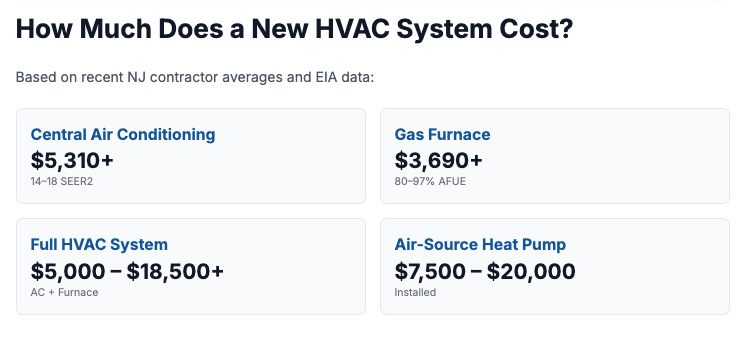
Central Air Conditioning (14–18 SEER2): $5,310+
Gas Furnace (80–97% AFUE): $3,690+
Full HVAC System (AC + Furnace): $5,000–$18,500+
Air-Source Heat Pump (15–20 SEER2 / 8.5–12 HSPF): $7,500–$20,000 installed
High-efficiency systems cost more upfront but typically reduce annual operating expenses by 20%, depending on your home’s insulation, ductwork condition, and usage patterns.
What affects HVAC replacement cost?
Home size and layout: Larger homes require bigger HVAC systems or multiple units to heat and cool effectively. Complex layouts with multiple floors or open-concept designs may also require additional ductwork or zoning, which can increase installation costs.
Ductwork condition: Older or poorly insulated ducts can leak air, reducing efficiency. Replacing or repairing ductwork ensures your system operates at peak performance, but it adds to the upfront installation cost.
Electrical or gas line upgrades: Some homes may need updated electrical panels, circuits, or gas lines to support modern high-efficiency equipment. These upgrades are critical for safety and system performance, and they can add several hundred to thousands of dollars to a project.
Efficiency rating of chosen equipment: Higher SEER (for AC), AFUE (for furnaces), or HSPF (for heat pumps) ratings improve energy efficiency and reduce operating costs over time. However, higher-rated units typically cost more upfront due to advanced components and technology.
Added features: Optional add-ons like Wi-Fi smart thermostats, air purifiers, or humidifiers can improve comfort and indoor air quality. While these features enhance your home environment, each addition increases the overall installation price.
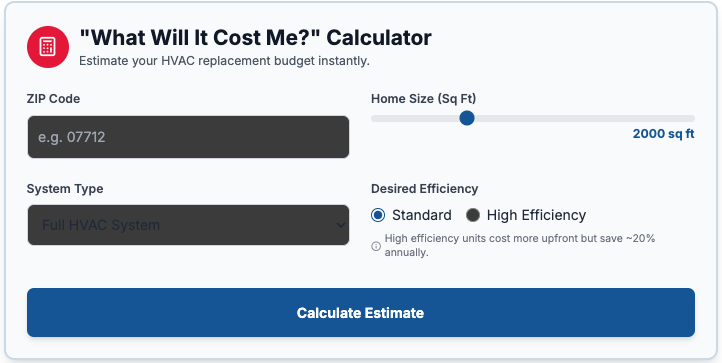
Wouldn't it be nice if there was an HVAC replacement cost estimator that you could use to make a budget plan? Check out our What Will it Cost Me? Calculator.
How Much Does Energy Cost in New Jersey?
Once your new system is in place, your annual operating costs matter just as much.
Because New Jersey combines cold winters, warmer summers, and above-average electricity rates, HVAC energy use can add up swiftly.
Heating (natural gas): New Jersey is in the top ten for cheapest natural gas, averaging $18.15 per thousand cubic feet (approximately $1.75 per therm). A typical NJ home uses around 660 therms/year for heating, which puts the average winter heating cost at about $1,200 per year.
Cooling (electricity): According to the EIA, air conditioning accounts for 19% of a home’s electricity use. With the average NJ household using 662 kWh per month and an electricity rate of 18.9¢/kWh, homeowners typically spend around $24 a month or $288 per year on cooling.
HVAC energy cost: Putting these averages together, the typical New Jersey homeowner can expect to pay around $1,488 per year on heating and cooling energy.
What affects your energy costs?
Home size: Larger homes require more energy to maintain a comfortable temperature. Open floor plans or multiple-story buildings may require additional heating or cooling zones, which increases energy usage.
Insulation quality: Poor insulation lets heat escape in winter and enter in summer, forcing your HVAC system to work harder. Upgrading insulation, sealing leaks, or adding weather stripping can reduce energy costs.
HVAC system efficiency: Older or lower-efficiency units consume more energy for the same comfort. Replacing aging equipment with high SEER, AFUE, or HSPF models can cut operating costs significantly.
Weather variability: Colder winters and hotter summers increase heating and cooling demands. Being aware of seasonal forecasts can help you plan energy-saving strategies like pre-heating or pre-cooling your home.
Preferred comfort settings: Maintaining higher or lower temperatures than necessary can substantially increase energy consumption. Using programmable or smart thermostats to optimize schedules helps reduce unnecessary usage.
Local utility rate: Electricity and natural gas rates vary by provider and location. Shopping for competitive rates or taking advantage of time-of-use plans can help lower your monthly bills.
Cost-Control and Efficiency Tips for NJ Homeowners
You don’t have to ride out rising HVAC costs. There are proactive steps you can take to manage and reduce your total spend.
1. Schedule Regular Maintenance
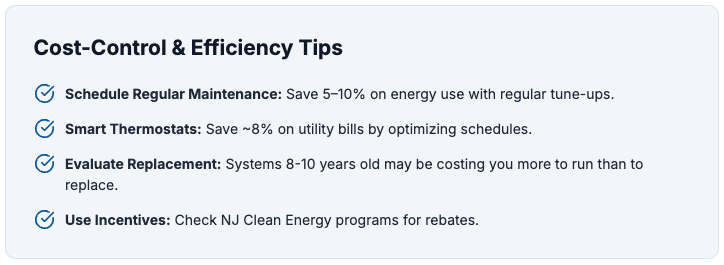
According to the U.S. Department of Energy, a well-maintained HVAC system can save 5–10% on energy use by keeping components clean, lubricated, and operating efficiently. Maintenance plans, like those from A.J. Perri, help you stay on top of tune-ups and early issue detection.
2. Upgrade to a Smart Thermostat
Smart thermostats let you optimize schedules, reduce runtime during peak demand, and adjust to your daily rhythm. Data from the Environmental Protection Agency shows that Energy Star smart thermostats can help save homeowners 8% on their utility bills.
3. Evaluate System Replacement
If your HVAC equipment is 8–10 years old, it may be time to consider system replacement. New high-efficiency models (with better SEER, AFUE, or heat-pump tech) aren't just a technology trend. They can significantly reduce operating costs.
4. Home Efficiency Upgrades
Insulation, better windows, and weather sealing reduce HVAC load, ensuring your system lasts for the longest time possible. Consider energy-efficient building codes guidance or work with contractors who specialize in home efficiency upgrades.
5. Use Energy Programs and Incentives
Look into NJ Clean Energy programs and incentives on HVAC upgrades. Local utilities and state energy programs often run rebates or financing support. Many HVAC companies offer coupons, rebates, or financing to help make the cost of replacement or high-efficiency equipment more manageable.
Plan Smart, Stay Comfortable with A.J. Perri
Rising energy costs can feel out of your control, but with the right data and strategy, you can take proactive steps to manage your HVAC expenses. This HVAC market forecast is designed to help you see the trends, understand what drives your monthly bills, and plan for both short-term and long-term decisions.
If you’re ready to take action, A.J. Perri’s experts are here to help you. Our team can provide you with an HVAC replacement cost estimate and recommend custom, energy-efficient systems for your home. Schedule a service or call 732-733-2541.